Around the international airport Schiphol (Amsterdam, the Netherlands) lies an extensive road network. Sjaak Haasnoot, team leader at Schiphol Fire Department, is responsible with his team for aircraft incident response and basic fire service operations at and around Schiphol: "I think that if you have CRS, no single vehicle type is a challenge anymore."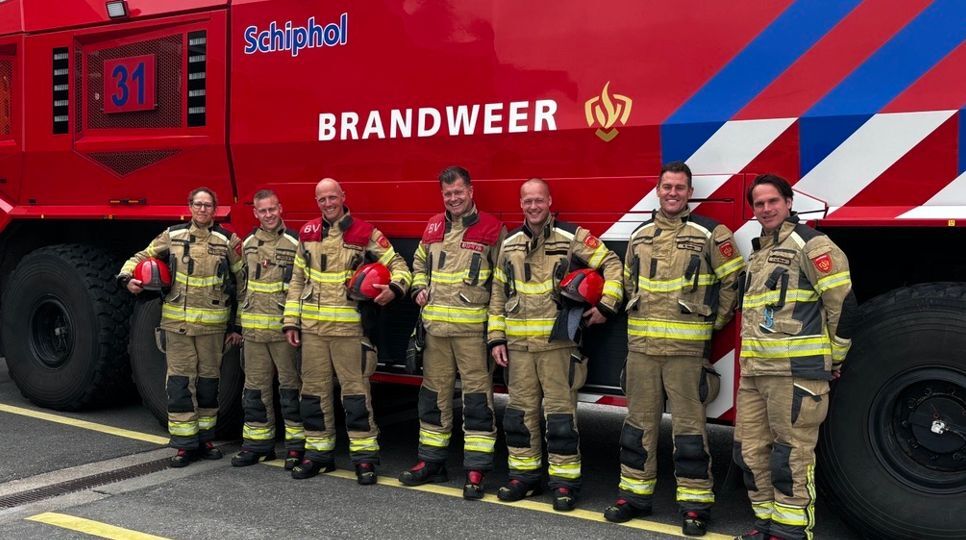
Schiphol Fire Department deals with many types of incidents, but these are certainly not always aviation-related. Traffic accidents regularly occur on the road network surrounding the large airport. Sjaak explains why using the Crash Recovery System is crucial in these situations.
"Often it's people dropping someone off or picking someone up, who aren't very familiar with the area and are looking around while driving. This regularly leads to incidents involving vehicles on the motorways or other roads surrounding Schiphol," says Sjaak.
The CRS has already proven its value in many situations
There have been many situations in which the value of the CRS has proven itself for Schiphol Fire Department. For example, there was recently an incident involving an electric Volkswagen ID4 and a Fiat Punto. Sjaak recounts:
"We looked up the Punto, with the driver still inside, by its number plate and immediately marked on the car where the pressure vessels and reinforcements in the doors are located. Using all the crucial information from the CRS, we were able to make both cars safe and free the driver quickly and safely from her difficult situation."
And about another occasion:
"A Volvo XC90 Plug-in Hybrid had collided with an arrow vehicle. Because the front end was badly crumpled, we couldn't get good access to it. We were able to disconnect the battery, but voltage remained present. By looking up the car in the CRS, it turned out there was also a battery in the boot. Because we now knew the exact location, we were able to make the Volvo completely de-energized."


Operational value and personal safety
The preceding examples clearly show that the CRS has changed collaboration and communication between responders at the scene of an incident, where the Schiphol Fire Department team was operational.
"Because the team that arrived first had precisely marked where cuts could and could not be made in the vehicle, the second team could start the operation immediately upon arrival. In this way, the CRS contributed to faster decision-making during the incident; through short, clear communication, work was carried out very quickly and efficiently, and no valuable time was wasted."
The use of the CRS also has an impact on the personal safety of responders at vehicle accidents. Because rescuers know exactly where potential hazards such as batteries, airbags, and seatbelt pretensioners are located, they can act safely and confidently.
The most challenging vehicle types and situations safety
The rapid developments in modern vehicle technology are resulting in a growing number of electric and other alternatively powered vehicles, which in turn plays a role in the need for the CRS.
Sjaak underlines this: "Yes, the CRS helps enormously with electric vehicles; these have a growing share on Dutch roads and present the biggest challenges and dangerous situations. Knowing the exact location of things like the battery pack helps us enormously. I think that if you have CRS, no single vehicle type is a challenge anymore."
The use of the CRS also has an impact on the personal safety of responders at vehicle accidents. Because rescuers know exactly where potential hazards such as batteries, airbags, and seatbelt pretensioners are located, they can act safely and confidently.
On implementation and use in practice
At Schiphol Fire Department, the CRS is fully integrated into the daily workflow and dispatch procedures. All vehicles have access to an iPad running the iOS version of the Crash Recovery System.
"At every incident involving vehicles, the CRS is consulted. The dispatch center also uses the CRS. They pass on to us all the information already known about the vehicles involved. Make, model, number of doors, and license plate are often known in advance."
The use of the CRS also has an impact on the personal safety of responders at vehicle accidents. Because rescuers know exactly where potential hazards such as batteries, airbags, and seatbelt pretensioners are located, they can act safely and confidently.
User-friendliness of the CRS
Schiphol Fire Department is also very satisfied with the user-friendliness of the CRS -- no small matter for an application used at moments when every second counts. The feedback we received from Sjaak's team:
"In principle, the CRS requires little to no explanation. You type in the license plate or search manually for the make and model, and the CRS Rescue Sheet appears automatically. If you're at an incident involving multiple vehicles, you can switch between them by saving them as a favourite -- you can then find them in the vehicle list. You can set it to search for updates automatically, but this is often handled by an administrator."
Would you recommend the CRS to other fire departments or emergency services?
"Yes, 100%. I would truly recommend it 100%. And I honestly couldn't think of a reason to advise anyone against it, because as a fire department or emergency service you really can no longer do without the Crash Recovery System," concludes Sjaak Haasnoot.
Want to know how the Crash Recovery System can help you or experience a live demo?
Contact sales or book a demo